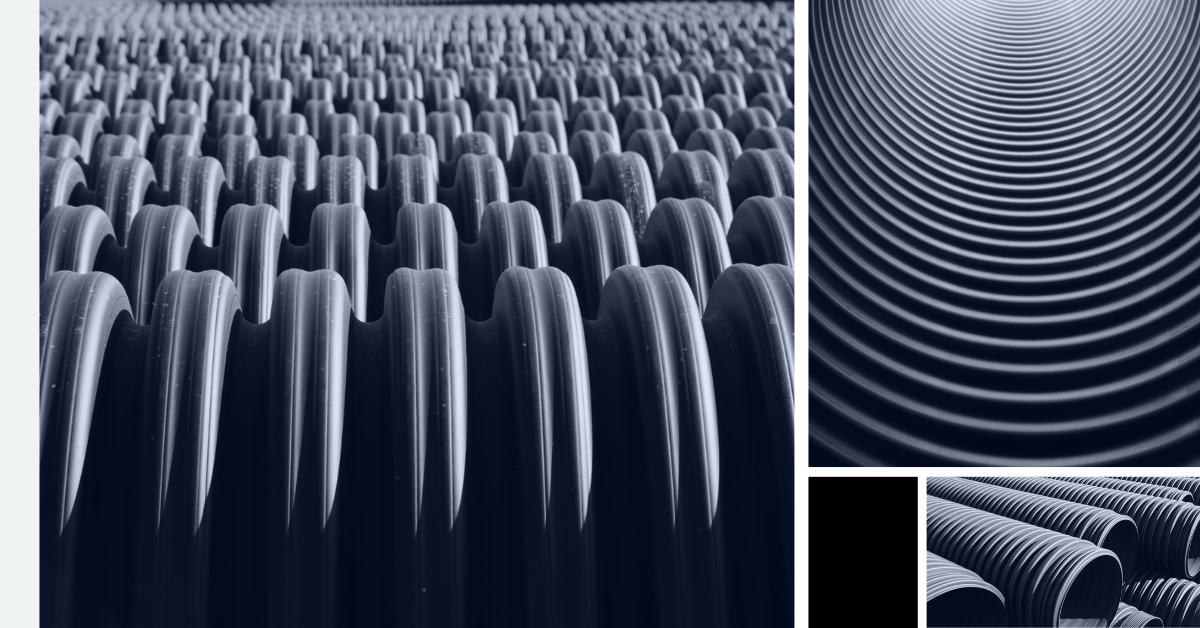
Storm drain systems fail when the wrong pipe goes in the ground. Not immediately — but over years of load cycles, soil movement, and hydraulic stress, undersized or misspecified HDPE corrugated pipe for storm drain applications cracks, deflects, and compromises the entire drainage structure.
Selecting the right HDPE corrugated pipe for storm drain isn’t complicated — but it requires knowing which specifications actually matter on the job. This guide covers the criteria engineers and contractors use to make the right call: wall type, load rating, applicable standards, and installation requirements.
Why HDPE Corrugated Pipe for Storm Drain Outperforms the Alternatives
HDPE corrugated pipe for storm drain has displaced concrete and metal alternatives across highway, municipal, and residential projects — for measurable reasons.
Weight-to-Strength
Equivalent load-bearing capacity at a fraction of concrete’s weight. Lower handling costs, faster installation, less equipment on site.
Hydraulic Efficiency
Smooth interior liner maintains Manning’s n = 0.012 — comparable to concrete, with zero degradation over time.
50-Year Service Life
Installed correctly, HDPE corrugated pipe for storm drain carries a 50-year design life per AASHTO and FHWA guidelines.
Single-Wall vs. Dual-Wall HDPE Corrugated Pipe for Storm Drain
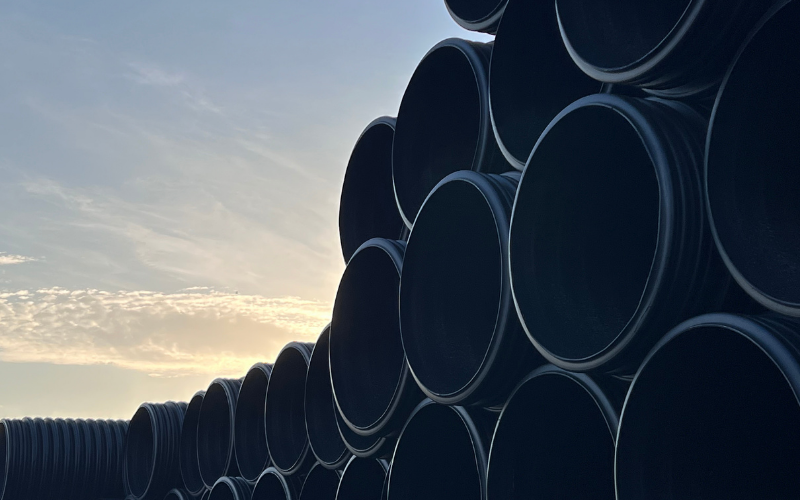
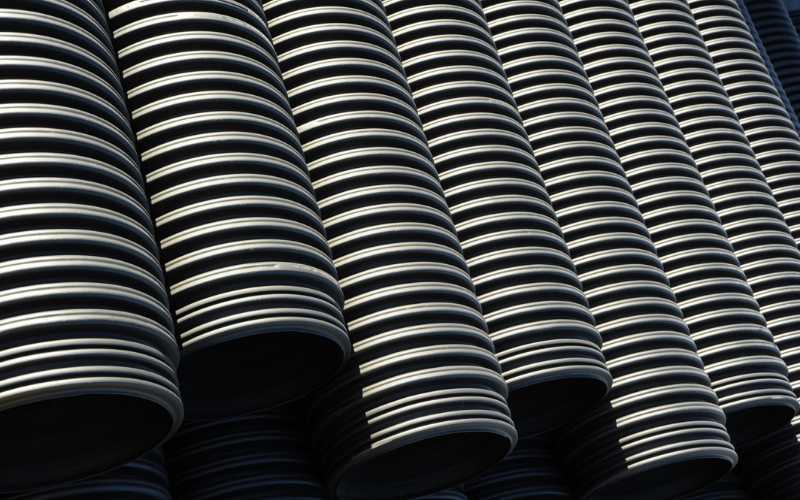
The most fundamental selection decision when specifying HDPE corrugated pipe for storm drain is wall type. Getting this wrong means specifying a product that won’t meet structural or hydraulic requirements.
| Feature | Single-Wall HDPE | Dual-Wall HDPE |
|---|---|---|
| Standard | ASTM F405 / AASHTO M252 | ASTM F2648 / AASHTO M294 |
| Interior surface | Corrugated | Smooth liner |
| Hydraulic efficiency | Low | High — Manning’s n 0.012 |
| Storm drain use | Not recommended | Standard specification |
| Structural rating | Low cover / low load | Full municipal / highway load |
TDR Ultra® is a dual-wall HDPE corrugated pipe for storm drain manufactured to ASTM F2648 and AASHTO M294 Type S, available in diameters from 4″ through 60″.
Key Specifications for HDPE Corrugated Pipe for Storm Drain Projects
TDR Ultra® dual wall pipe is engineered as a solid dual wall pipe priced competitively for municipal budgets. The corrugated soil tight solid dual construction ensures stability under varying soil conditions, making it the preferred choice for engineers specifying HDPE corrugated soil tight solid pipe for storm drain infrastructure.
Not all HDPE corrugated pipe for storm drain performs equally. These four specifications determine real-world performance:
- Resin quality — Virgin PE4710 HDPE resin only. Recycled or off-spec resin may pass dimensional checks but underperform under sustained load.
- Ring stiffness — AASHTO M294 specifies minimum pipe stiffness of 46 psi (Type S). Confirm PS values match your design depth and soil conditions.
- Joint integrity — Watertight performance per ASTM D3212. Specify gasketed bell-and-spigot or coupling joints tested to ASTM D3212.
- Cover requirements — Minimum 12 inches under unpaved and paved surfaces for AASHTO M294 Type S pipe.
| Diameter | Typical Application |
|---|---|
| 4″ – 12″ | Roof drain leaders, small site drainage |
| 15″ – 24″ | Residential and commercial storm drain |
| 30″ – 48″ | Municipal collector systems, highway drainage |
| 54″ – 60″ | Major trunk lines, regional drainage infrastructure |
Installation Requirements for HDPE Corrugated Pipe for Storm Drain
HDPE corrugated pipe is a flexible pipe system. Its structural performance depends on the interaction between the pipe and the surrounding soil envelope — installation quality directly determines service life.
- Bedding — Crushed stone or gravel per ASTM D2321 Class I or II. Minimum 4-inch depth under pipe haunches.
- Haunching and backfill — Compact uniformly to 6 inches above pipe crown. Poor haunching is the #1 cause of excessive deflection.
- Compaction — 90% Standard Proctor density in haunch zone. Verify with field density testing per ASTM D698.
- Deflection limit — Post-installation deflection must not exceed 5% of nominal pipe diameter.
- Joint assembly — Clean surfaces, approved lubricant only. No petroleum-based products on HDPE gasketed joints.
Poor haunching is the primary cause of excessive deflection in flexible pipe systems. Compact correctly the first time — it’s not correctable after final backfill.
TDR Pipe Technical Team
Specify TDR Ultra® — HDPE Corrugated Pipe for Storm Drain
Specifying HDPE corrugated pipe for storm drain isn’t a commodity decision. The difference between a 50-year drainage system and a problem at year 10 comes down to wall type, resin quality, joint specification, and installation execution.
TDR Ultra® is manufactured to ASTM F2648 and AASHTO M294, uses virgin PE4710 resin, and ships from distribution centers in Houston TX, Laredo TX, Hemet CA, and Mission TX.
Need pipe specs, load tables, or installation support? Our technical team is here. Not an automated system. A person who knows pipe.