HDPE Pipe Compaction: The 12/24/36 Rule and What Equipment Goes In at Each Cover Depth
Corrugated HDPE pipe does not carry the load by itself. The pipe-soil system carries it together. That single fact makes HDPE pipe compaction the work that most determines how the line performs, and also the work that is easiest to get wrong. This guide covers which equipment can operate at each cover depth, what density each specification calls for, and what ASTM D 2321 flatly prohibits.
The rule at a glance
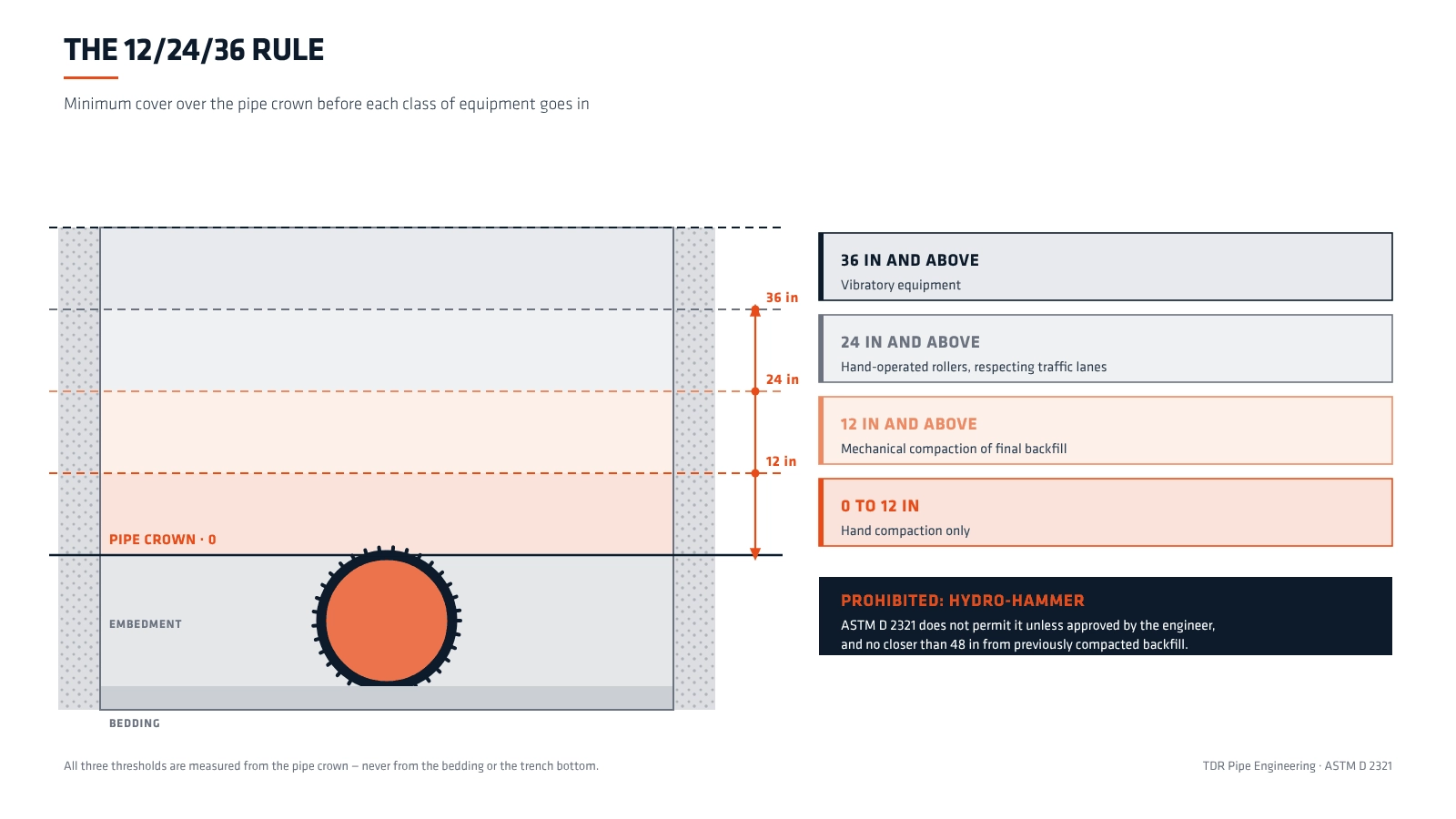
- 0 to 12 in of cover: hand compaction only
- 12 in and above: mechanical compaction of the final backfill may begin
- 24 in and above: hand-operated rollers, respecting traffic lanes
- 36 in and above: vibratory equipment directly over the pipe
- Haunching and embedment: 8 in maximum lifts per side, 90 to 95% Proctor
- Prohibited: hydro-hammer, unless approved and no closer than 48 in
Why compaction decides how a flexible pipe performs
A rigid pipe resists load on its own: when the soil fails, the pipe cracks. A flexible pipe works the other way around. It deflects slightly under vertical load, pushes outward against the soil at its sides, and that soil pushes back. The pipe and the embedment resist the load together.
The consequence governs everything that follows: the soil around the pipe is part of the structure. Poorly compacted haunching is not a finishing detail, it is a missing structural element. That is why HDPE pipe compaction belongs in the specification with the same rigor as the pipe itself.
It also creates the tension this article resolves. You need thorough compaction, but the equipment that compacts well is the same equipment that can deform the pipe if it goes in too early. The 12/24/36 rule is the field answer to that tension.
The 12/24/36 rule of HDPE pipe compaction
All three numbers refer to cover measured from the crown of the pipe — never from the bedding, never from the trench bottom, never from existing grade. Misreading that reference point is the single most common and most damaging error on a job site. One easy way to keep it straight: the three thresholds are simply one, two and three feet of cover.
0 to 12 in: hand compaction only
The initial backfill placed directly over the pipe must be compacted by hand wherever compaction is required. No mechanical equipment operating over the crown. This is the most sensitive band of the entire installation, because the pipe does not yet have enough soil mass above it to spread the impact.
12 in and above: mechanical compaction begins
Mechanical compaction of the final backfill directly over the pipe should not begin until cover is at least 12 in above the crown. From that point on, the soil distributes the equipment’s energy across a wide enough area that it no longer reaches the pipe as a point load.
24 in and above: hand-operated rollers
Hand-operated rollers may be used once cover exceeds 24 in over the crown, and only while respecting the traffic lanes. That second condition gets overlooked constantly. A roller should not track in any direction it pleases across a freshly backfilled line.
36 in and above: vibratory equipment
Vibratory equipment may not operate directly over the pipe until the placed backfill reaches a minimum of 36 in of cover. Vibration is the most effective compaction method in granular soils, and for exactly that reason it is the most aggressive toward a pipe that does not yet have enough cushion above it.
Taking it to the crew
The rule works as a ladder: 12 for mechanical, 24 for rollers, 36 for vibratory, always measured from the crown. Short enough to memorize, specific enough to inspect. It is worth printing and posting in the field office.
Before the rule comes the haunching
Every discussion of HDPE pipe compaction starts above the crown, and that is already half a step too late.
HDPE pipe compaction does not start above the crown. It starts at the sides, and that is where most of the structural support is won or lost.
Haunching begins immediately after the pipe is laid, and it is the stage of HDPE pipe compaction that carries the most structural weight. The load-carrying capacity of an installed pipe depends largely on the material surrounding it, and that material should be a homogeneous granular soil: crushed stone, gravel, ballast or a comparable angular aggregate.
| Parameter | Criterion | Why it matters |
|---|---|---|
| Lift thickness | 8 in maximum per side | Thicker lifts do not compact uniformly through their full depth |
| Density | 90 to 95% Proctor | The range that holds deflection inside the acceptance criterion |
| Material | Class I, II or III | Clean granular soils; plastic fines do not provide reliable side support |
| Maximum aggregate size | About 2½ in | Larger aggregate will not seat in the valleys between corrugations |
| Voids | Filled with Class IA material | A void is missing side support, no matter how good the rest of the lift is |
| Vertical extent | 12 in over the crown | The zone that ties the haunching to the final backfill |
Two procedural points that rarely appear on drawings and frequently appear in field problems. First: backfill material must never be dumped directly onto the pipe. Second: when impact tampers are used, the lifts on both sides of the pipe have to stay even, because compacting one side ahead of the other displaces the pipe instead of supporting it.
Why the aggregate has to seat in the corrugation valleys
This is where corrugated pipe differs from smooth wall. The embedment material has to seat fully in the valleys — the space between corrugations. If the aggregate is too coarse it bridges from crest to crest and leaves a continuous void underneath that no amount of surface compaction will close. That is the reason for the maximum aggregate size, and the reason to verify the pit material before accepting it.
Matching equipment to soil type
Cover depth tells you when a machine may go in. Soil type tells you which machine belongs there in the first place.
In HDPE pipe compaction, equipment selection does not depend on cover depth alone. It also depends on what you are compacting, and the logic is straightforward.
- Cohesive and clay soils: impact tampers. Impact energy is what rearranges fine cohesive particles.
- Granular soils: vibration. Coarse particles consolidate by rearrangement, not by impact.
- Tight trench conditions: pneumatic or mechanical impact tampers are generally the most effective option.
- Adjacent to existing utilities: 4 to 6 in lifts compacted with light equipment such as hand rollers, vibratory plates or tampers.
That last case deserves attention because it shows up constantly in built-out urban corridors, where a new trench runs within inches of an existing line. The risk there is not only the pipe being installed, but the one that was already in the ground.
HDPE pipe compaction density requirements by specification
This is where HDPE pipe compaction stops being a procedure and becomes a contractual criterion, because ASTM and AASHTO do not ask for the same thing.
| Reference | Soil class | Minimum standard Proctor |
|---|---|---|
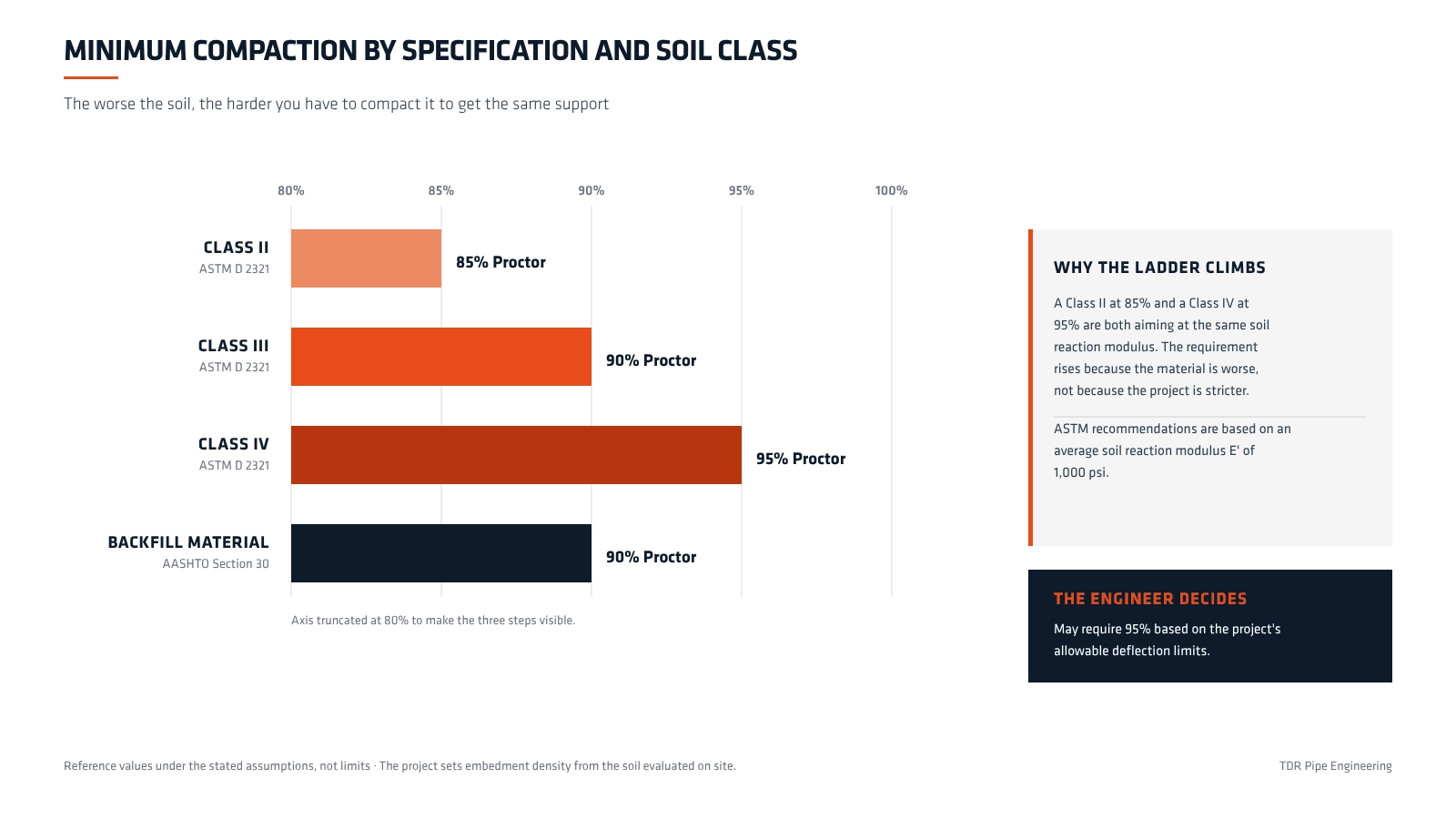
| ASTM D 2321 | Class II | 85% |
| Class III | 90% | |
| Class IV | 95% | |
| AASHTO Section 30 | Backfill material | 90% |
| Engineer’s call | Based on allowable deflection | May require 95% |
The logic behind the ASTM ladder is what explains everything else: the worse the soil, the harder you have to compact it to get the same support. A Class II at 85% and a Class IV at 95% are both aiming at the same soil reaction modulus. These ASTM recommendations are based on an average soil reaction modulus E’ of 1,000 psi.
One caution worth repeating plainly: the project establishes embedment density based on an evaluation of the soil actually present at the site. It is not safe to assume these minimum Proctor values apply to every job. The values above are reference figures under the stated assumptions, not limits. For project-specific conditions, TDR Pipe Engineering runs the structural analysis.
Moisture content: the variable almost nobody measures
It is the hidden input of HDPE pipe compaction and the most frequent reason a Proctor target goes unmet.
You can have the right equipment, at the right cover depth, over the right material, and still miss the density. Moisture content is usually why.
All backfill material must be placed and compacted at optimum moisture content. The two references quantify it differently:
- ASTM D 2321: Class II, Class III and Class IVa soils require a minimum moisture content of 3%.
- AASHTO: requires a range of -3% to +2% relative to optimum moisture.
Material that is too dry will not transmit compaction energy between particles. Material that is too wet behaves like a fluid and springs back the moment the equipment lifts. Moisture conditioning and material uniformity should be verified and approved by the inspector.
What ASTM D 2321 explicitly prohibits
The hydro-hammer
ASTM D 2321 does not permit the use of a hydro-hammer unless it is approved by the engineer and kept no closer than 48 in from previously compacted backfill. This is not a best-practice suggestion. It is a condition of the installation standard, and that standard is commonly incorporated into the contract.
And why the jumping jack is the equipment most likely to damage the pipe
Using a rammer or jumping jack calls for particular care, and the reason is counterintuitive. The vertical impact force the machine applies to the soil is lower than the horizontal force. But the vertical component is the one transmitted straight down into the pipe, and it is the one that can damage it.
There is a practical difficulty alongside it: it is hard to exceed 85% compaction in the areas immediately above the pipe crown, precisely because the full available energy cannot be applied there. That zone needs dedicated inspection to reach adequate density without compromising the pipe. If the specification calls for 90% or more in that band, plan the lift sequence and the equipment accordingly rather than discovering the conflict in the field.
Five HDPE pipe compaction mistakes that show up as deflection
1. Measuring cover from the trench bottom
The 12/24/36 figures are measured from the crown. Measuring from the bedding means bringing equipment in with far less cover than the standard allows, right in the most vulnerable zone.
2. Compacting one side ahead of the other
Haunching is compacted in matched lifts on both sides. Working one side all the way up first pushes the pipe laterally and pulls assembled joints out of alignment.
3. Oversized lifts to save time
A 16 in lift does not compact uniformly. It ends up dense on top and loose underneath — a result that passes a surface test and fails as side support.
4. Accepting pit material without checking aggregate size
Aggregate that is too coarse will not seat in the corrugation valleys and leaves continuous voids that no later compaction will correct.
5. Dumping material directly onto the pipe
Beyond the impact damage risk, it ruins the HDPE pipe compaction of that lift by producing an uneven distribution that forces recompaction of zones already considered complete.
How to specify compaction in a bid document
A line item that only says “backfill compacted to 90%” leaves out nearly everything that determines the outcome. A complete HDPE pipe compaction specification covers five points:
- Soil class permitted for embedment and for final backfill, with the required Proctor density for each.
- Maximum lift thickness in the embedment zone and in the final backfill.
- Minimum cover over the crown for each class of equipment.
- Moisture content required, and who verifies it.
- Governing installation standard: ASTM D 2321, AASHTO Section 30, or both.
Frequently asked questions about HDPE pipe compaction
Where are the 12, 24 and 36 in measured from?
Always from the crown of the pipe — its outside top surface. Not from the bedding, not from the trench bottom, not from existing grade. This is the most common point of confusion and the one that causes the most damage, because it leads crews to bring heavy equipment in with far less cover than the standard requires.
Can I run a jumping jack over the pipe?
Only once there is at least 12 in of cover over the crown, which is when HDPE pipe compaction may move from hand work to mechanical equipment. Even then it calls for care: the vertical impact force is the component transmitted into the pipe and can damage it, and it is difficult to exceed 85% compaction in the areas immediately above the crown.
At what cover depth can I bring in a vibratory compactor?
Vibratory equipment may not operate directly over the pipe until backfill reaches a minimum of 36 in of cover over the crown. It is the highest of the three thresholds because vibration is the most aggressive compaction method relative to the pipe.
What density should I require in the haunching?
HDPE pipe compaction in the haunching zone runs between 90 and 95% standard Proctor. The exact figure depends on soil class and on the project’s deflection criterion: ASTM D 2321 recommends 85% for Class II, 90% for Class III and 95% for Class IV, while AASHTO Section 30 sets a 90% minimum for backfill material. The engineer may require 95% based on allowable deflection limits.
Why are lifts limited to 8 in?
Because in HDPE pipe compaction a thicker lift does not compact uniformly through its full depth — the equipment’s energy dissipates before it reaches the bottom. The result is a lift that is dense at the top and loose underneath, which passes a surface test but does not deliver the side support the pipe needs.
Can a hydro-hammer be used near the pipe?
ASTM D 2321 does not permit it unless approved by the engineer and kept no closer than 48 in from previously compacted backfill. Verify this condition before mobilizing the equipment, since the standard is commonly incorporated into the contract.
What happens if the material is too dry?
HDPE pipe compaction will not reach the required density even with correct equipment and procedure, because without moisture the particles do not rearrange. ASTM D 2321 requires a minimum moisture content of 3% for Class II, III and IVa soils; AASHTO calls for a range of -3% to +2% relative to optimum moisture.
How do I know the compaction is right without waiting for the test?
Control HDPE pipe compaction lift by lift, not at the end: verify lift thickness, material moisture and achieved density before placing the next one. Deficient compaction found two lifts later cannot be corrected by compacting harder above it, because the void is below.
Engineering support
The HDPE pipe compaction criteria in this guide are reference values under the stated assumptions, not limits. When a project involves unusual cover depths, heavy live loads, close proximity to existing utilities, or soils outside the typical range, TDR Pipe Engineering performs the project-specific structural analysis. Call (830) 830-5011 to reach our team.
TDR Pipe manufactures dual-wall corrugated HDPE pipe for storm drain, highway, agricultural and industrial applications, with yards in Houston, Laredo and Mission, Texas, and Hemet, California.